

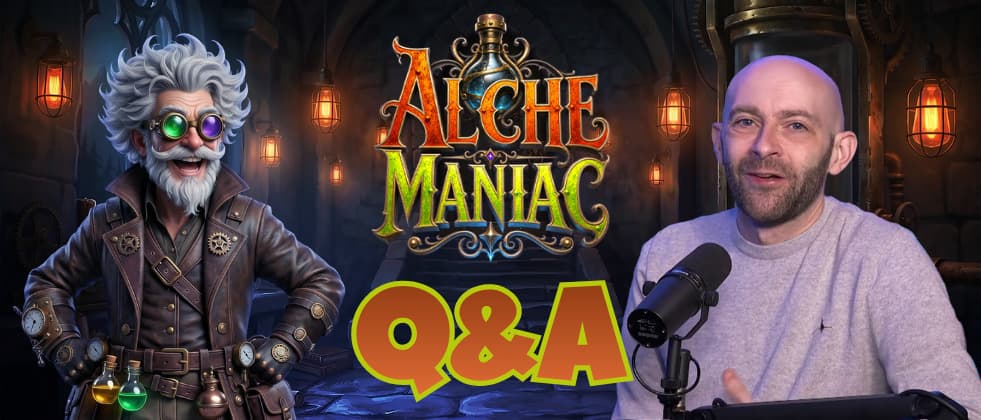
DreamSpin studio may not be a household name (yet), but it consistently sticks to its path to becoming one by releasing solid slots based on proven mechanics, sprinkled with a bit of safe ingenuity. And while some critics may say that such an approach can face a challenging upward trajectory, there are undoubtedly players who like to return to familiar ground for a relaxing spinning session. In the latest interview we handled with Josh Green, a co-founder of DreamSpin, he emphasised that the team always tries to create slots that feel thoughtfully designed. Releases like Wizards of Wild Wood and Aztec Tower fortify that statement, offering rich, detailed worlds and meticulously crafted gameplay. Today, we're taking a closer look at the creation process of the studio's latest production, Alchemaniac, and we sat down with Will Barnes, the studio's co-founder and CTO to talk about the game.
Hi Will! Happy to have you for another round of questions about your latest production. Can you tell us what's been going on at DreamSpin since our last talk about Aztec Tower a few months back?
DreamSpin: Thanks for having me! It’s been a really busy few months for our team. Aztec Tower launched in May, and since then the majority of our focus has been on Alchemaniac, which goes live in September.
Behind the scenes, our roadmap is busier than it’s ever been. We’ve got Rage of Thor coming in November, along with our fifth release of 2026 coming in December, rounding the year off nicely. Beyond this, we have three more games currently in production for release in early 2027. We’re getting into a good position now where we have a more consistent flow of releases, which is something we’ve been working towards for a long time.
Great to hear! How did Aztec Tower perform in the first months after the release compared to the rest of your portfolio?
DS: We’ve been really pleased with the response to Aztec Tower. It was an important release for us – it was our first official game through Yggdrasil, and we felt the work we put into it had really paid off by the time it launched.
What has been really encouraging is seeing players engage with the progression in the game. The combination of cascades, the growing multiplier and the Enhancers really gives the feeling that each sequence is building towards something impressive, especially during Free Spins. This is exactly what we wanted to achieve.
Our catalogue is still young enough that we try not to draw huge conclusions from one game, but Aztec Tower has given us a lot of confidence in the direction we’re heading.
Can you describe your process of brainstorming and selecting a theme for the game, and why you landed on alchemy in the case of Alchemaniac?
DS: We don’t always start with the theme. Sometimes the mechanic comes first, or sometimes it’s a broader visual concept. In the case of Alchemaniac, we considered a few different themes.
We knew we wanted a setting that could support quite a lot happening on the grid without it feeling disconnected or overwhelming. Alchemy was ultimately the answer to this – you’ve got experimentation, transformations, reactions and this slightly manic pursuit of creating something valuable, which naturally lends itself to the mechanics and features.
When we landed on alchemy the name ‘Alchemaniac’ was also one of the things that stood out the most to us – we felt it was catchy and unique.
What impressions are you hoping to give the players with the design when they enter the game for the first time? Are there any special practices you apply to make the game more appealing?
DS: The first thing we want is for players to understand the personality of the game very quickly. Alchemaniac is a bit darker, but it’s also energetic and deliberately a little chaotic, so we want that to come across. Lots has gone into making this game appealing, with extra attention given to ambiance and lighting, animations, and sound effects.
At the same time, there’s a balance. A game can have lots of features and great artwork, but if players don’t understand what’s happening then you’ve lost them. We’ve spent a lot of time fine-tuning the visual hierarchy and animations so that when something important happens, the player immediately notices it.
That attention to detail is a big part of our overall philosophy. We want every title to feel purposeful and memorable, rather than adding visual elements just for the sake of having more on screen.
Cluster-paying slots with a feature queue activated by collecting wins or special symbols have been around since productions like Reactoonz by Play'n GO. How is Alchemaniac going to stand out from the competition?
DS: We certainly didn’t invent the concept, so for us the challenge was building around these foundations to create something that is uniquely ours.
The Enhancer system and how it works is where we think Alchemaniac has its own identity. The Enhancers we’ve chosen (and how they work together) were a big focus for us. Additionally, the ability to upgrade these to Supercharged Enhancers is one thing that we think will stick with players.
And as you said in your review, so often the Enhancers do result in wins. We put a lot of effort into the mathematical balancing of Alchemaniac to ensure players could see this value and feel the continued excitement, whilst still creating space for huge wins to form.
We’ve always said we’re not trying to reinvent the wheel with every release. We’d rather take mechanics players already understand and enjoy, and find ways to refine and combine them to make the overall experience feel fresh.
What made you choose those four particular Enhancers you included in the game? Were there others on the table that you discarded for some reason?
DS: There are always more ideas than what ends up in the final product! However, having already tackled Enhancers in a few of our other releases, we knew what we wanted pretty early on.
The four we settled on affected the grid in different ways and gave us a good mixture of immediate help and effects that can set up further wins in a cascading sequence. They also gave us opportunities to really set things apart in the animations and effects.
More importantly, they each complement each other, which was our biggest focus. We wanted the Enhancers, when triggered in sequence, to clearly work well together – like when all premiums are upgraded to the highest paying premium and then Wilds are added to connect them all, or a huge Mystery Block drops in the middle revealing a matching symbol. So we spent a long time brainstorming the most interesting four features that would interact well together.
What are your predictions for Alchemaniac's performance? Is it going to become a leader of your portfolio?
DS: We’d love it to! Internally there’s a lot of excitement around Alchemaniac, and we think it stands out as one of our most polished releases – we definitely think it’s very strong, especially visually.
That said, players decide what games become the leaders of a portfolio. One of the most interesting parts of creating games is that you can have your own favourites, release them into the real world, and see players react differently. There are also so many different markets with different preferences, so what becomes a leader in one may not resonate as well in another.
We’re confident in Alchemaniac, but we’re even more interested to see what players make of it.
DreamSpin is slowly but surely pushing forward, as we can see from the planned roadmap. However, most games so far stick to rather safe, proven mechanics. What's your strategy for the future? Are we going to see something completely experimental at some point?
DS: Our approach so far has been quite deliberate. We’re a young independent studio, and there’s real value in starting with mechanics players understand and finding our own ways to develop them. I think players would also be surprised to know just how long a game can be in production, then testing, then marketing, before it hits their screens – especially in a smaller team that is working on a smaller number of titles simultaneously.
We have to balance the risks with what we know is popular right now, whilst also balancing the expected release date. What is popular now may not be popular in six months, but some mechanics and features stand the test of time.
But experimentation is a big part of what happens internally, and our team are constantly batting ideas back and forth – some closer to what we already know and some that are pretty out there. We have to use our discernment when deciding what to proceed with. As the studio grows and our catalogue gets bigger, we’ll have more freedom to take bigger swings.
You’ll start seeing more of that variety as the roadmap develops. The games we have in production and testing right now aren’t all following the same template, and that’s important to us.
I can tell you that we’re showcasing our first unique mechanic at the end of this year. It’s something we’re very excited about, and it’s a new twist on something we know is popular, but produced in a way that we think will really resonate with players.
Thank you for the comprehensive look into your creative process and plans about your future roadmap. We wish you further successes in your journey, and we look forward to playing your next games. Thanks for joining us!